High-Availability Pumping Systems: Advanced Power & Control Solutions

Category :

Hardware Design, Firmware Development, Cloud & IoT Integration

Client :

ETASS (Malta)

The Challenge

Ensuring Uninterrupted Water Distribution for Agricultural Use

We partnered with a Maltese system integrator for a project aimed at modernizing the control systems for a distributed water infrastructure, ultimately serving agricultural needs for a major local water utility. The project presented a multifaceted challenge:
• Power Redundancy and Management: The system required a robust power solution capable of accepting a 48V DC input from the existing network and accommodating for a local 30W solar panels with Maximum Power Point Tracking (MPPT). Crucially, it needed to seamlessly switch between these power sources to ensure continuous, uninterrupted operation with a 48-hour battery backup, avoiding any perceived disruption. The solution also had to deliver up to 40W, providing power for battery charging, intermittent solenoidal valve activation (12V at 2.5A peak), and stable lower voltage rails (12V, 5V, and 3V).
• Comprehensive Control and Monitoring: Beyond power, the control system demanded precise management of mechanical and solid-state relays for valve and load control, accurate water quantity measurement via a pulse meter, and three analog-to-digital converter (ADC) inputs for essential voltage monitoring (battery, 48V bus, solar panel).
• Connectivity, Security, and User Interaction: The system required secure fiber optic LAN connectivity, robust tamper detection for both door opening and water pulse meter manipulation, and an integrated RFID reading system to facilitate user authentication and credit-based water dispensing.

Our Solution

An Integrated, Resilient Water Distribution Control System

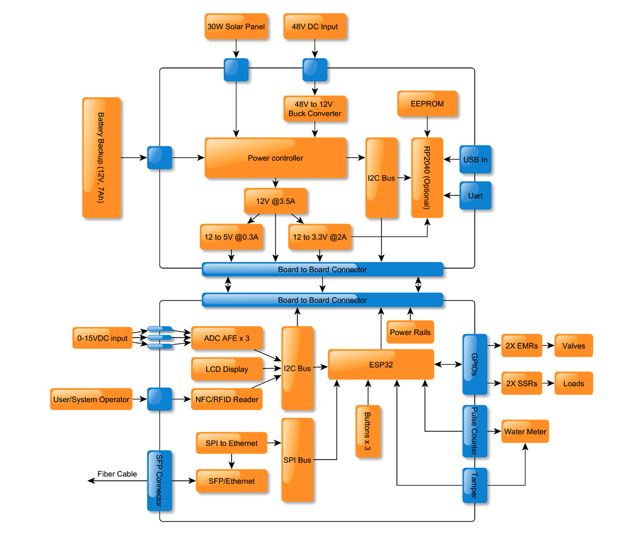
To address these complex requirements, we developed a two-board solution: a dedicated power management board and a feature-rich control board, designed for seamless integration and robust performance. A detailed architectural view of the system is shown in the picture.

The Power Board (Top Section) was engineered for continuous power supply, managing multiple inputs including a 48V DC grid and up to 30W of solar power via an integrated MPPT controller. It features a 48V to 12V buck converter for primary power distribution and seamlessly switches between inputs without interruption. This board also incorporates a 12V, 7Ah battery backup system, providing up to 48 hours of autonomous operation with its own charging circuitry. It efficiently delivers up to 40W, supplying 12V for high-demand loads like solenoidal valve activation (with a 2.5A peak current capability), along with regulated 5V and 3.3V outputs for the control board's various peripherals.
Designed as an independent PCB, the Power Board physically nests with the control board using robust board-to-board connectors.

The Control Board (Bottom Section) serves as the central processing unit, integrating all operational functionalities. It incorporates an ESP32 microcontroller to manage system logic and communications. Key hardware integrations include:

• Two mechanical relays for water valve activation and two solid-state relays for controlling additional loads.
• A pulse counter input for precise water quantity measurements from a pulse meter.
• Three Analog-to-Digital Converter (ADC) inputs for monitoring critical voltages: battery, 48V bus, and solar panel.
• An integrated Wiznet W5500 Ethernet controller for fiber LAN connectivity, enabling robust communication with a cloud system over HTTP.
• Dedicated tamper protection circuits for door opening and water pulse meter manipulation.
• An RFID reading system for user authentication and managing water dispense credits, compatible with standard RFID cards.

Complementing the hardware, we developed the entire firmware codebase. This custom firmware, running on the ESP32 microcontroller, oversees the initialization and control of all integrated sensors and peripherals. Its core responsibilities include:
• Managing tamper conditions.
• Accurately processing pulse inputs from the water meter.
• Handling user authentication and credit management via the RFID system.
• Controlling the relays for water dispensing and other loads.

The firmware is designed for robust operation, even in offline conditions, and communicates with a cloud system over HTTP. For remote management, the system supports Over-the-Air (OTA) updates, alongside comprehensive remote control and diagnostic monitoring capabilities for elements like controller status, battery, and solar voltage. This ensures high maintainability and adaptability for future enhancements.

What’s involved: Ethernet connection, Fiber SFP, ESP-IDF, I2C, SPI, Analog Measurements, Cloud Integration, Driver Development, Circuit Design

Prev Project
Senior Safety
Next Project
UNICT