Senior Safety

Modular Sensing for Adaptive IoT Solutions

Category :

Hardware Design, Firmware Development, IoT

Client :

Senior Safety (Italy)

Project Description

A sensor-based platform designed to enhance the safety and well-being of elderly individuals living independently.

The Challenge

Addressing the need for adaptive sensing solutions

The expansion of connected environments, particularly in domestic and indoor settings, necessitates advanced sensing capabilities. Conventional sensor deployments often present limitations in flexibility, making the integration of diverse sensor types, from environmental to inertial, cumbersome. The challenge was to develop a versatile hardware and firmware architecture capable of intelligent, real-time recognition and seamless management of various detachable sensing elements, thereby ensuring adaptability and future-proofing for evolving application requirements.

Our Role

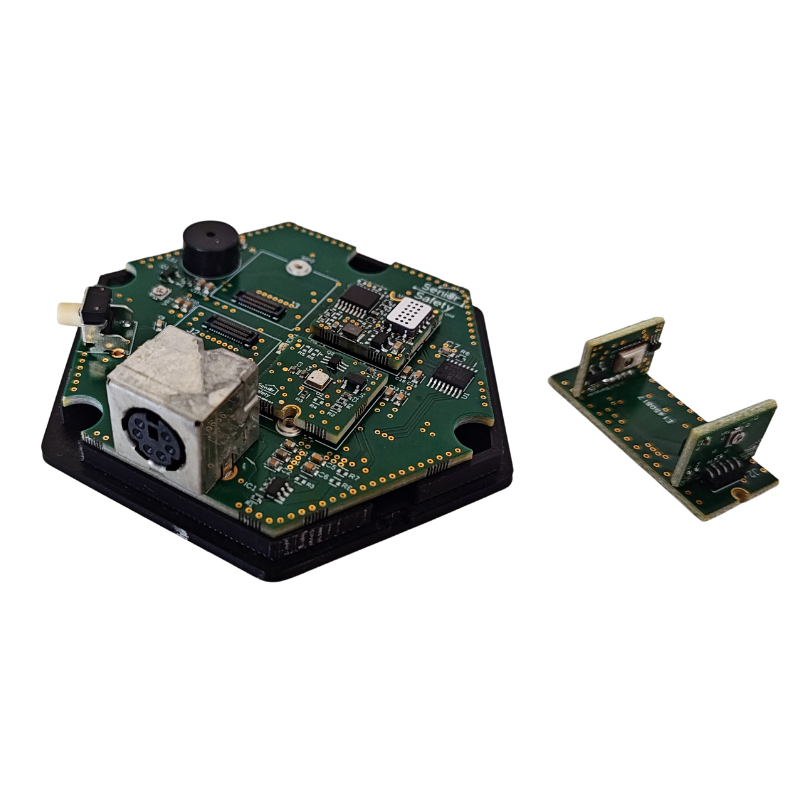
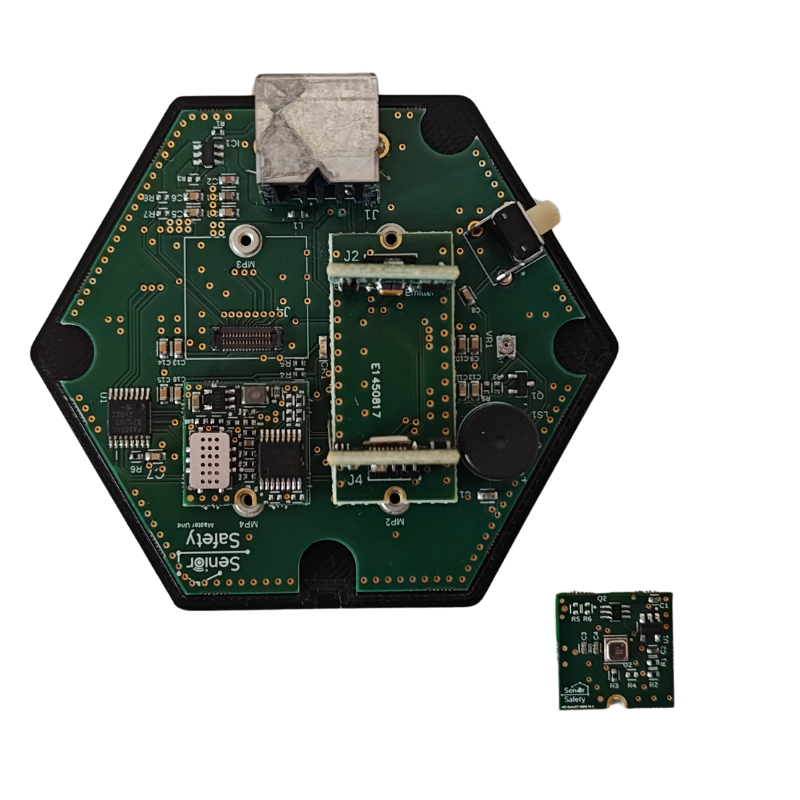
We joined an ongoing project and assumed responsibility for the hardware development of the full suite of devices, with a particular focus on the environmental sensor pictured. This sensor is part of a modular system that can be customized with various sensor types according to user requirements, including temperature, humidity, methane, CO2, and air quality sensors. Additionally, we developed a unified firmware architecture to enable autonomous operation of each device over a LoRaWAN network.

Results

Systematized Flexibility and Operational Efficiency

This modular sensing platform yielded several key advantages. The reconfigurable hardware, coupled with digital sensor recognition, significantly enhanced system versatility, allowing for rapid adaptation to changing application requirements. This intelligent integration minimized deployment complexity, reducing both time and resources typically associated with multi-sensor installations. Connectivity for data transmission is provided via integrated Wi-Fi and LoRaWAN modules. Wi-Fi offers efficient local connectivity for domestic environments, while LoRaWAN extends capabilities to large environments where a distributed Wi-Fi network may not be feasible. Ultimately, the solution provides clients with a scalable and future-proof framework for diverse sensing deployments, particularly beneficial in dynamic indoor environments. What’s involved: LoRaWAN, WiFi, ESP-IDF, I2C, Chirpstack LNS

Our Solutions

A Modular, Digitally Integrated Sensing Platform

We engineered a modular sensing device featuring a reconfigurable hardware architecture designed for enhanced adaptability in connected environments. The core of this solution involves detachable sensing elements, with a max number of four different modules, interfaced with low-profile connectors to facilitate rapid connection and disconnection. This modular design along with the implementation of a digital detection system, allows the main firmware controller to automatically identify and initialize connected sensors upon insertion. Integrated within a broader technological framework, the device operates under the directive of a central controller, to which is wired, and that manages power distribution, data processing, and computational functions. Connectivity options include Wi-Fi and LoRaWAN for data transmission. Primarily designed for indoor environments, such as air quality monitoring, the device supports a diverse range of sensor types, including environmental and motion sensors. Its versatility renders it suitable for numerous applications. As a part of the development, the entire firmware stack of the central controller has been updated to allow the integration of this flexible hardware solution, allowing to:

  • Automatically detect the device presence
  • Automatically identify the sensor connected into the various slots and handling proper initialization and use
  • Handling power saving strategies
  • Allowing remote controls and telemetry over LoRaWAN
Next Project
ETASS